The world’s biggest sportswear brand trades near a 12-year low while much of the market sits at rich multiples. The value case is real, but it rests brand, not on this year’s earnings.
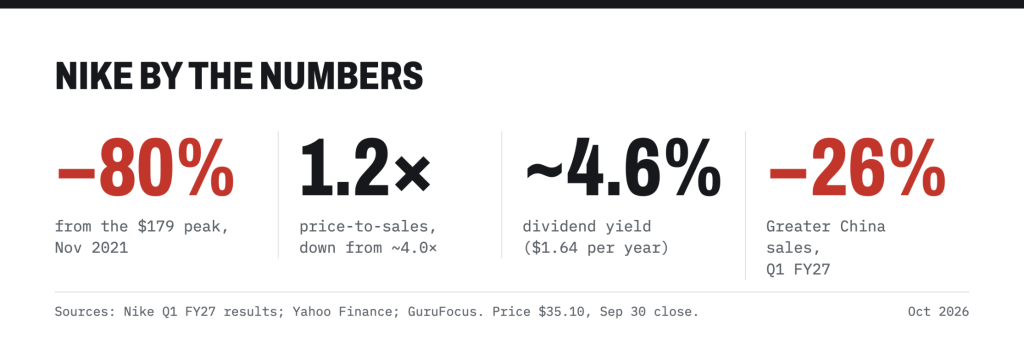
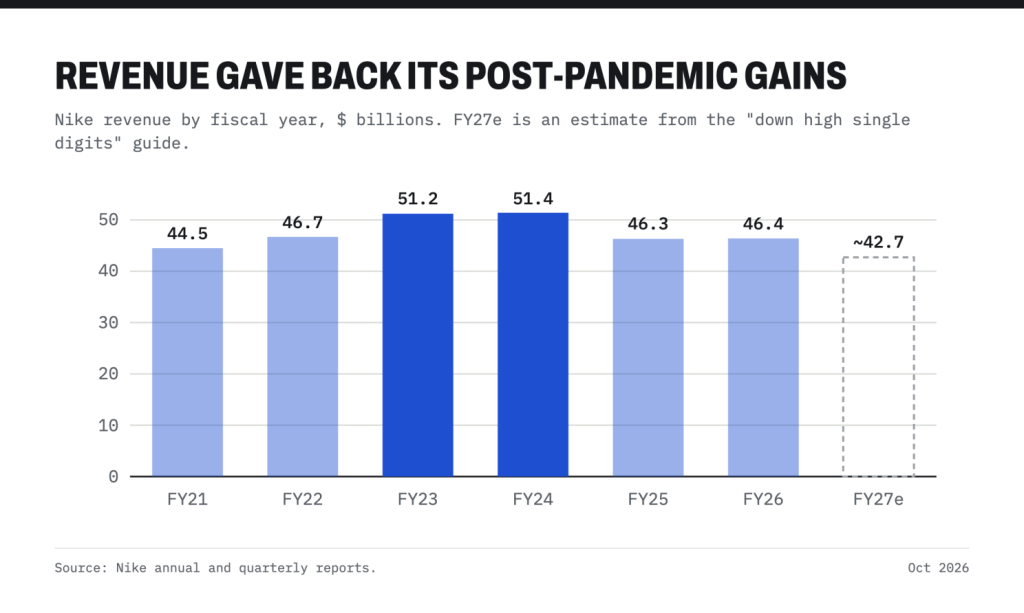
Nike reported fiscal Q1 2027 results on October 1. Earnings beat at $0.48 a share, but revenue fell 4% to $11.2 billion and the full-year guide landed below every analyst estimate: sales down a high-single-digit percentage and adjusted EPS of $1.15 to $1.35. Shares slid roughly 6–8% after hours, extending a 2026 decline of more than 40% that made Nike the worst performer in the Dow.
Why Nike is struggling
- China keeps shrinking. Greater China revenue fell 26% currency-neutral, the ninth straight quarterly decline, and accounted for about two-thirds of the company’s total sales drop.
- The direct-to-consumer bet backfired. Nike pulled product from retailers to sell it on its own app and stores. Shelf space went to On and Hoka. Nike Direct fell 6% last fiscal year and digital fell 12%, while wholesale grew 6% as Nike went back to its retail partners.
- Lifestyle franchises are being cut back. Management cut Dunk volume by nearly half to clean up an overexposed line. Sportswear fell at a low-double-digit rate and Jordan fell mid-teens.
- Tariffs. New Section 301 duties of 12.5% on China and Vietnam and 10% on Indonesia took effect July 24, covering nearly all of Nike’s shoe production.
The case for buying now
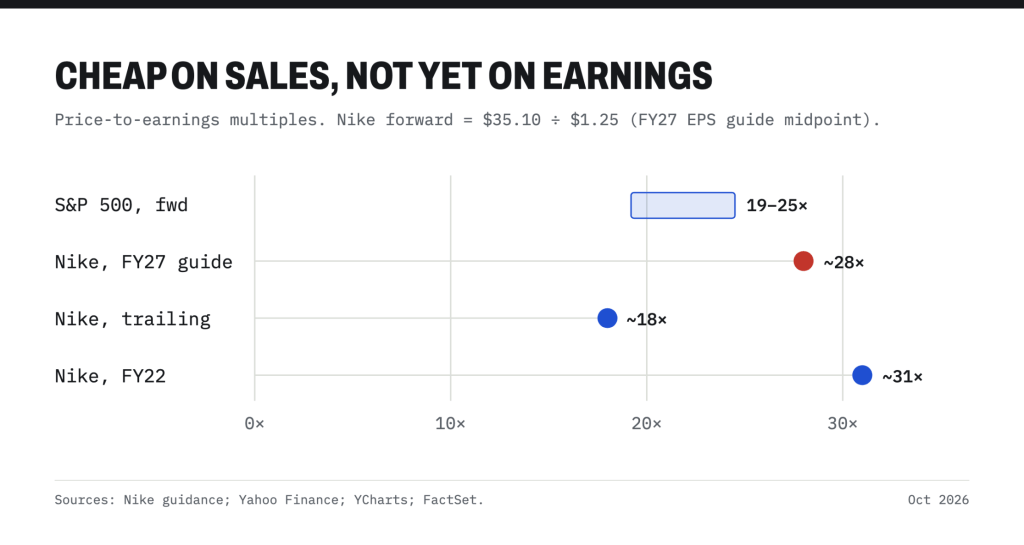
The broad market is not cheap. Depending on the data provider, the S&P 500 trades at roughly 19× to 25× forward earnings, much of it carried by a handful of richly valued tech names. Nike, by contrast, has been marked down to levels that assume the brand is permanently impaired.
- You pay 1.2× sales for a global category leader. At the 2021 peak investors paid about 4×. Market value has fallen from roughly $264 billion to under $60 billion.
- Margins are moving the right way. Gross margin rose 60 basis points to 42.8% last quarter, even through the inventory cleanup.
- The core is turning. Performance categories like running grew at a high-single-digit rate and North America grew 2%. The weakness is concentrated in China and lifestyle, which management is shrinking on purpose.
- A cost program is underway. The new “Pace” plan targets $2.5 billion in cumulative savings through fiscal 2031.
- You get paid to wait. The dividend yields about 4.6%, and the average Wall Street price target sits around $45–50, about 30% above today’s price.
What could go wrong
On the earnings Nike just guided to, the stock costs about 28×, more than the market. That is the catch. The bargain only exists if profits recover toward where they were a few years ago. The dividend needs watching too: $1.64 a year now exceeds the entire FY27 EPS range, a payout ratio of 121–143%. China has not found a floor, tariffs are a fresh cost, and management itself said the performance business is not yet large enough to offset the declines. Cheap stocks can get cheaper.
The bottom line
Nike looks like a value buy for an investor who believes the brand recovers and can wait two to three years for proof. You are buying a world-class franchise at about one times sales, with a cost plan and a clean-up already in motion. You are not buying cheap current earnings. A position sized to survive a few more bad quarters, or one built up gradually, fits the uncertainty better than one big bet on a quick rebound.
Disclaimer: This post is general commentary for education, not personal investment advice. Figures are from public reporting as of October 2, 2026, and differ slightly between sources. Do your own research or speak with a licensed advisor before investing.
Sources: Nike Q4 FY26 release (SEC) | MarketBeat, Q1 FY27 call highlights | StockTitan, Q1 FY27 earnings and dividend | 24/7 Wall St., Oct 2, 2026 | Grafa, after-hours move | Yahoo Finance, valuation and FY26 data | GuruFocus, dividend yield | YCharts and FactSet, S&P 500 forward P/E


Leave a comment