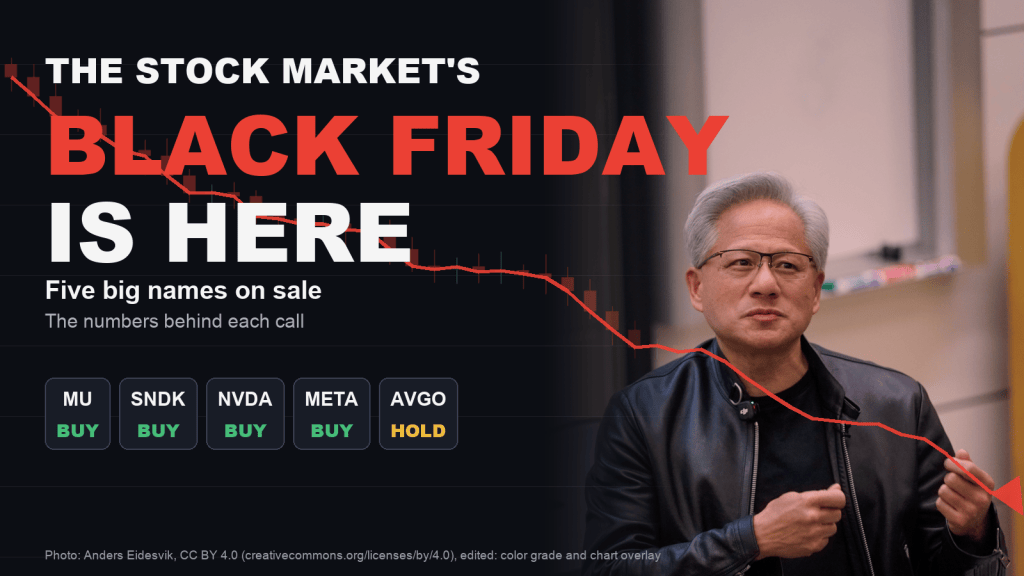
Black Friday is days away, and the stock market already ran its own sale.
The Nasdaq-100 closed Nov 20 at 25,029, about 20% below its Oct 6 record of 31,224. It fell 5.6% on that one day and briefly touched bear-market territory. Many people are asking whether this is the dot-com bubble bursting. The numbers say it’s a different market.
This isn’t the dot-com bubble
| Nasdaq-100 P/E | Dot-com peak (Mar 2000) | Today |
|---|---|---|
| Forward P/E | about 60x | about 16-19x |
| Trailing P/E | 150-200x (Nasdaq est.) | about 29-33x |
- Then: Investors paid 60 times expected earnings, and well over 100 times actual earnings.
- Now: The index is at about 16x expected earnings, below its 5-year median of about 24x. In October it was about 21x. It got a lot cheaper in a few weeks.
- The difference: In 2000, many of the companies had no earnings. The five stocks below made billions in the latest quarter, and each has a guided next quarter.
Cheap isn’t the same as safe. The worry now is whether AI spending pays back, not today’s multiples. But a market at 16x is priced very differently from one at 60x. After screening large tech companies, all over $20B in market cap, on price-to-earnings (P/E), price-to-earnings-growth (PEG) and price-to-sales (P/S). Five stood out: four buys and one hold.
Why this isn’t a normal cycle
Memory and chip stocks have a reputation for boom and bust. A low P/E on a cyclical company often means earnings are at a peak. This time is different, because the money is already committed:
- Micron: More than 75% of fiscal 2027 shipments are already under customer contracts or allocations. Long-term agreements with 26 customers cover about 35% of production bit volume through 2030.
- Sandisk: Signed multi-year contracts carry $88.9B of remaining value, with about 20% due to be recognized as revenue over the next 12 months.
- Nvidia: Next-quarter revenue is guided to $130B, plus or minus 3% (the quarter has an extra week).
- Meta: 2026 capex is guided to $135–145B.
- Broadcom: Next-quarter AI chip revenue is guided to $21.7B, up 236% from a year ago.
These chips are needed for the next few years, and the buyers have signed. Contracts can be renegotiated and spending plans can change, and the selloff is the market betting on that. The numbers say the bet is too pessimistic.
1. Micron (MU): Buy
- Valuation: $673B market cap. Forward P/E 3.4x, trailing 8.0x. PEG 0.06. P/S 5.1x. The stock fell 13.9% on Nov 20 to $594.51.
- Latest quarter (fiscal Q4): Revenue $54.2B. Adjusted EPS $33.42.
- Next quarter’s guide: $60–63B in revenue and adjusted EPS of $37.15–39.15.
- Why buy: At a forward P/E of about 3x, the price assumes earnings collapse. The contract coverage above says they won’t, at least through next year.
2. Sandisk (SNDK): Buy, smaller position
- Valuation: $90B market cap. Forward P/E 2.6x, trailing 5.1x. PEG 0.07. P/S 3.1x. It split 8-for-1 on Nov 20 and closed at $79.24, down 16% on the day.
- Latest results (quarter ended Oct 2): Revenue $11.0B, up 378% from $2.3B a year ago. Gross margin 85%, against 30% a year ago.
- Why buy: $88.9B of signed contracts gives the business a base.
- Why smaller: A 16% one-day drop shows it is the most volatile name here.
3. Nvidia (NVDA): Buy, smaller position
- Valuation: $3.03T market cap. Forward P/E 8.7x, trailing 13.5x. PEG 0.18. P/S 8.4x. It fell 14% on Nov 20 to $125.53.
- Latest quarter (reported Nov 17): Revenue $115.8B, up 103% from a year ago. Data center revenue $107.6B, up 110%. Gross margin about 75%. Adjusted EPS $2.68.
- Guidance: $130B next quarter, plus or minus 3%. It assumes zero China data center compute revenue, so a China headline has little effect on the forecast.
- The baggage: Jensen Huang has left as CEO, and the SEC is reportedly examining the company’s accounting. Our view is that this is temporary. The board says Huang isn’t coming back, and Ian Buck, who runs its AI hardware and software business, is among the leading internal candidates. Apple made a similar change from Steve Jobs to Tim Cook and kept growing. Trump said on Nov 20 that “we’re a country of second chances” in calling for Huang to get one. If the SEC finds problems, this call is wrong.
- Why buy: About 9x forward earnings for a company growing revenue 103%.
4. Meta (META): Buy
- Valuation: $1.43T market cap. Forward P/E 17.0x, trailing 19.1x. PEG 0.88. P/S 5.9x. History: its forward P/E at each year-end from 2021 to 2025 averaged about 21.7x (range 16.4–24.7x), so it is at the low end of its own range.
- Latest quarter (Q3): Revenue about $64.6B, up 26%. Q4 is guided to $73–76B.
- AI traction: The Muse app launched Sept 8 and reached about 10.9M downloads in roughly six weeks, with about 2.5M daily users by mid-October. Seven-day retention was about 30%, against about 19% for ChatGPT, Claude and Grok (Sensor Tower estimates). Its Muse Spark model scores 52 on the Artificial Analysis Intelligence Index, in the top five of the models it benchmarks.
- The catch: Capex is guided to $135–145B, and Q3 free cash flow was negative $2.1B. A $9.9B legal charge also cut Q3 operating income by 37%.
- Why buy: A business growing revenue 26% at 17x forward earnings, with an AI product showing early traction.
5. Broadcom (AVGO): Hold
- Valuation: $1.45T market cap. Forward P/E 17.5x, trailing 38.9x. PEG 0.32. P/S 16.3x trailing, 9.2x forward. It fell 12% on Nov 20 to $304.41.
- Latest quarter (fiscal Q3): Revenue $29.6B, up 86%. AI semiconductor revenue $16.7B, up 221%. Adjusted operating margin about 68%. Q4 is guided to $34.8B, up 93%.
- Why hold, not sell: It’s an excellent business. On forward earnings it is priced like Meta, and its PEG is lower. But it costs about 2.8 times Meta’s P/S and 1.9 times Nvidia’s, and its trailing P/E is double Meta’s. Rather own the cheaper names first.
The five at a glance
| Stock | Market cap | Fwd P/E | PEG | P/S | Verdict |
|---|---|---|---|---|---|
| Micron | $673B | 3.4x | 0.06 | 5.1x | Buy |
| Sandisk | $90B | 2.6x | 0.07 | 3.1x | Buy (small) |
| Nvidia | $3.03T | 8.7x | 0.18 | 8.4x | Buy (small) |
| Meta | $1.43T | 17.0x | 0.88 | 5.9x | Buy |
| Broadcom | $1.45T | 17.5x | 0.32 | 16.3x | Hold |
What to take from this
- A low P/E is only a bargain if earnings hold.
- All five are tied to AI spending, so they fall together if that story breaks. This is one bet, not five.
- The selloff could go on. Nov 20 alone took 5.6% off the Nasdaq-100, so staging purchases beats a single bet.
Opinions, not personalized investment advice. This is general commentary, not advice for any person’s situation. Do your own research.
Cover photo: Anders Eidesvik, CC BY 4.0, via Wikimedia Commons. Edited: color grade and chart overlay.


Leave a Reply